- Work Hours : Mon to Sat : 09:30- 18:30
Resection and reconstruction planning for tumour and cancer
with Immediate Fibula
Free Flap and 3D Printing Technology

- Designed by Zoriox Innovation Labs ,Marketed by Graft3D Healthcare Solutions
Overview
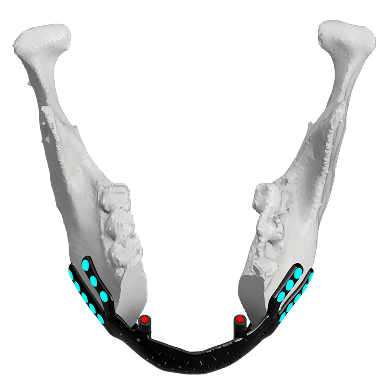
Reconstruction of the maxilla and mandible after oncologic or traumatic resection is necessary not only to restore oral function and facial harmony but also to improve the general well being of patients. Advanced microvascular techniques integrated with digital planning and 3D printing have redefined the landscape of maxillofacial reconstructive surgery, empowering the surgeon to create patient specific,accurate results.
Immediate Fibula Free Flap in Jaw Reconstruction
Fibula free flap is the gold standard for reconstruction of the mandible and maxilla. Its unique advantages include:
- Sufficient bone to preserve continuity of the maxilla or mandible.
- Reliable vascularity, ensuring graft survival.
- Ease of use with availability of skin paddles for intraoral or external coverage.
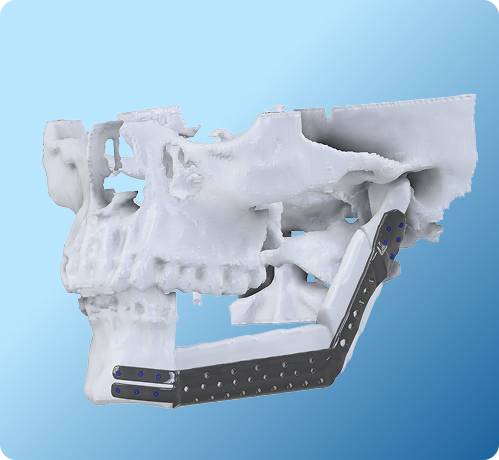
Immediate reconstruction with the tumor resection offers the best functional and aesthetic reconstruction. It preserves the soft tissue envelope, minimises post-operative scarring, and facilitates earlier rehabilitation.
3D Printing in Virtual Surgical Planning
3D Printing and VSP have revolutionized craniofacial reconstruction in a way providing surgeons with a digital-to-clinical workflow that enhances precision and predictability.
Key Applications
- 3D-Printed Resection/Cutting Guides: Facilitate precise resection margins and accurate fibular osteotomies, ensuring accurate execution of the surgical plan from the digital plan.
- Custom Titanium Cranioplasty Plates: Designed using preoperative CT scans, these plates provide rigid stabilization, restore anatomical morphology, and eliminate the requirement of bending plates during surgery.

Advantages of a Digital Workflow
The combination of 3D printing and virtual planning provides several clinical advantages:
- Form, Symmetry, and Occlusion restored with great precision.
- Minimized intraoperative timeframe with guided performance.
- Consistent improvement in chewing, speaking, and appearance.
- Improved patient satisfaction associated with superior functional and aesthetic results.
Pre Planned Dental Implants: “Jaw in a Day” Approach
One of the most significant developments in maxillofacial reconstruction has been the opportunity to combine intraoperative dental rehabilitation with the surgical reconstruction.
- With VSP, occlusion and prosthetic requirements are established by the surgeon prior to surgery.
- Dental implants are pre installed into the fibula segment through a 3D printed drill guide.
- Implants are installed with the preoperatively designed occlusion following microvascular transfer.

Benefits
- Immediate or early loading of the prosthesis, shortening treatment times.
- Precise registration of implants with opposing dentition.
- Quicker Recovery, no need for numerous staged surgeries.
Clinical Impact
Fibula free flap reconstruction combined with 3D printing surgical templating, patient-specific plates, and pre-designed dental implants is the most advanced surgical modality in reconstructive maxillofacial surgery. This single session, computer-aided process makes it possible to obtain structural and functional restoration and facial aesthetics, which enables patients to recover more quickly and better in daily life.
1) What does reconstruction of the maxilla and mandible involve?
Reconstruction of the maxilla and mandible involves rebuilding the upper and lower jaw bones after trauma, cancer surgery, or congenital defects. Techniques often combine implants, bone grafts, and personalized planning to restore form and function.
2) How does a mandible reconstruction implant 3D print help surgeons?
A mandible reconstruction implant 3D print is designed from patient imaging to match jaw geometry precisely. This helps surgeons plan and place the implant with improved fit, reducing surgery time and supporting better functional outcomes.
3) What is fibula free flap mandibular reconstruction recovery like?
Fibula free flap mandibular reconstruction recovery typically involves monitoring flap viability, gradual diet progression, and physical therapy for jaw movement. Recovery durations vary, and multidisciplinary follow‑up ensures both bone and soft tissue healing proceed well.
4) How does mandibular reconstruction with bone graft differ from other techniques?
Mandibular reconstruction with bone graft uses harvested bone (often from the hip or tibia) to rebuild the jaw. Unlike free fibula flap, it may not include its own blood supply, so careful planning and stabilization are critical for graft integration.
5) What is involved in mandibular reconstruction with free fibula flap?
Mandibular reconstruction with free fibula flap transfers bone (and sometimes skin) from the lower leg to the jaw. Microsurgical connection of blood vessels enables long‑term viability, while 3D planning improves contour and functional restoration.
6) When is maxillary reconstruction required in patients?
Maxillary reconstruction is required when the upper jaw’s bone or soft tissue is lost due to trauma, tumour removal, or congenital anomalies. Reconstruction restores facial support, chewing mechanics, and continuity between oral and nasal cavities.
Contact Us & Get details for
Reconstruction of the Maxilla and Mandible
with Immediate Fibula
Free Flap and 3D Printing Technology